Innovation in precast-concrete keeps sports centres on track

Corestruc bolsters crane fleet to keep pace with demand for precast-concrete reservoirs
August 26, 2022
Vhembe District Municipality harnesses precast-concrete technology for upgrade of Vondo Regional Water Scheme
June 5, 2023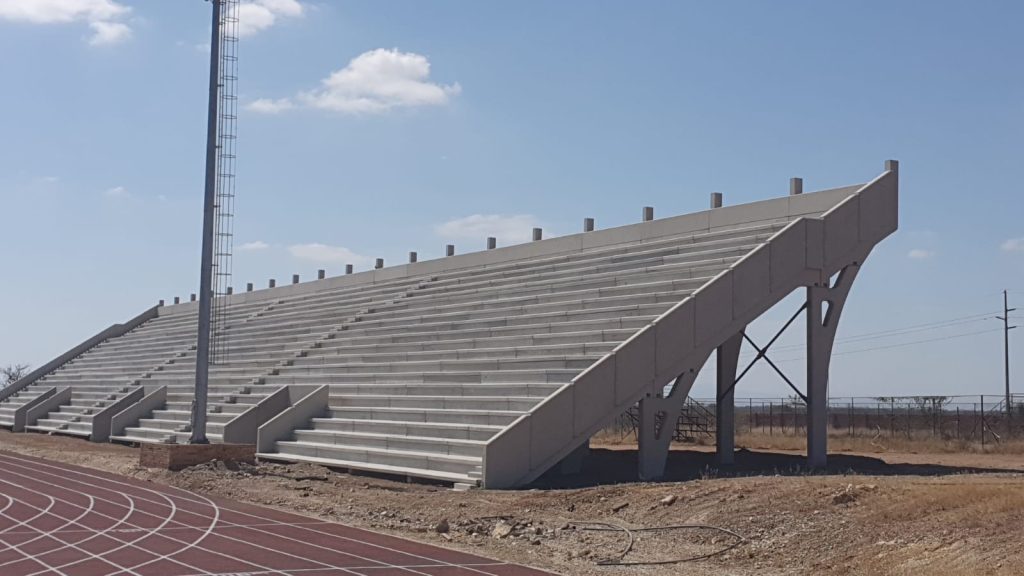
By Kobus Kotze, Director Infinite Consulting Engineers, and Willie de Jager, Managing Director of Corestruc
Municipalities are harnessing precast-concrete technology to help significantly fast-track the construction of large grandstands for community sports and recreational centres. The technology is also providing a more cost-effective means of building these structures and an end product of a higher quality, both in terms of durability and aesthetics.
However, one of the major benefits of the precast-concrete system is that it is helping to empower emerging contractors. The grandstand is the most complicated aspect of these projects. Constructing an in-situ structure with the same aesthetic design as the precast concrete grandstands deployed on these projects can only be undertaken by a handful of established contractors. While subcontracting the construction of the precast-concrete grandstand to a specialist in the field, emerging contractors are involved in all other aspect of the work scope. Among others, this includes the earthworks and site terracing; installation of the various services and perimeter fencing; and the construction of the buildings and the pitch. There are also many opportunities to train and develop members of communities located within the construction footprint and who are the beneficiaries of the final infrastructure.
A case in point is a sports and recreational centre that is being constructed in a municipal district in Limpopo. It is being built by an emerging contractor that has made steady progress on this Expanded Public Works Programme project.
It features a grandstand that is able to seat 3 500 people, making it the largest such structure to have been designed by Infinite Consulting Engineers and erected by Corestruc, to date. The companies have jointly built more than 20 grandstands in Limpopo over the years.
Constructing the grandstand in this manner has provided an almost 40% reduction in construction costs for the municipality. This is by eliminating the need to manufacture bespoke shutters and operating a tower crane for almost 12 months on site, among other preliminary and general costs associated with such a project.
The grandstand was erected in as little as four months. This is opposed to the 10 months it would have taken to build a similar structure using conventional in-situ techniques. Material procurement, such as the special shutters for the seating benches, columns, raker beams, side panels and closures, and establishing the stacking area, alone, would have taken almost four months using cast-in-place methods of construction. It would have taken three months just to construct the 9m-high back columns. This includes setting up the shutters and support, as well as the reinforcement and concrete works. Constructing the 20 bottom, middle and top raker beams and the seating using traditional cast-in-place methods would have been an onerous seven-month long process. It is for this reason that some municipalities will opt for less aesthetically appealing grandstands for their sports and recreational facilities. At times, they may be constructed from steel, which also requires more maintenance than concrete structures, increasing the total cost of ownership of the assets. In other instances, a very simple brick and mortar structure is built. However, this option is more suited to smaller facilities. This is despite many precast concrete structures having also been erected for smaller sports and recreational facilities, considering the numerous benefits that they also offer municipalities.
Coreslab commenced manufacturing the various precast-concrete elements for the grandstand in mid-October 2021. The manufacture of the 20 tapered columns, as well as 20 front-end and 20 top raker beams were completed in mid-January 2022. This is in addition to the more than 340 seating benches, 19 back benches, 34 side panels and 76 steps, as well as the structural steel bracing for the structure.
Meanwhile, the principal contractor commenced constructing the foundations and the cast in-situ bases for the structure in mid-October 2021. They were completed before the builders’ shutdown period that year to enable Corestruc to start erecting the structure in January 2022. This preliminary work included excavation; placement of the stabilised fill; and construction of the in-situ 10MPa concrete bases. Constructed in sound founding material, the concrete bases for the front raker beams and front columns are 3 200mm in width and length and 500mm thick. For the back columns, the concrete bases are 3 900mm in width and length and 600mm deep. The chemical anchors that are used to connect the precast concrete columns extend between 300mm and 400mm into the concrete bases and have pull-out resistance of more than 150kN.
A single column was installed a day, starting with the middle precast-concrete elements. The top of the columns was set out with coordinates to confirm the plumb and position. This was followed by the lining up of the front raker beams with the top and bottom bolts of the columns and then fastening them in place. Corestruc then installed the rear columns, again setting out the top of the precast-concrete elements with coordinates to confirm the plumb and position. Afterwards, the back columns were braced vertically with structural steel. By bracing the first and second, third and fourth, fifth and sixth, seventh and eighth, and ninth and tenth columns, five frames spaced 5,5m apart were created. This provided the critical stability that was required at this stage of the erection process, considering the slenderness of the columns. The top raker beams were then installed in the same way that the front elements were placed. Afterwards, they were braced horizontally in a similar sequence to that used for the back columns. This was followed by the placement of the many seating benches. They were lined up with the raker beams and then grouted into position and, in doing so, forming a single monolithic structure. The process was followed by the installation of the side panels and steps. This structure will feature a roof comprising galvanised structural steel elements, fixed to the concrete structure at strategic positions.
Infinite Consulting Engineers and Corestruc have been refining and perfecting this modular system since 2016. The focus has been on designing an “off-the-shelf system” that reduces erection time and only requires minor design modifications – if necessary. This has been achieved by standardising and reducing the number of prestressed precast-concrete elements, while the use of curved columns and flat surfaces for the rakers, benches and side panels has also facilitated quick and efficient installation. Infinite Consulting Engineers has also refined the method of connecting the various precast-concrete elements over the years. The columns are connected to the in-situ bases by components that have been cast into the precast concrete elements and secured using hold-down bolts in the base. The raker beams, seating benches and side panels are secured with dowels that fit seamlessly into sleeves that have been cast into the various precast-concrete elements and into which the grout is then poured. The dowels have also been strategically positioned to facilitate ease of installation. These innovations have ensured that clients derive maximum benefit from the precast-concrete technology.
The design team uses Building Information Systems to model the structures to further ensure precision. BIM creates models of each precast-concrete element and provides updated design statuses. It also facilitates quality control by enabling seamless tracking and tracing of each precast-concrete element from the design phase through to their integration on site.
Infinite Consulting Engineers also uses a suite of commercial software for structural analysis and design.
The production of the system was undertaken by Coreslab as an approved manufacturer. By undertaking the production of the various elements in a controlled factory environment, the professional team is able to deliver a final structure of a very high quality. The factory features a computerised batching plant and optimised curing processes. Enhanced mix designs are also deployed to produce the concrete that is used to manufacture the various precast-concrete elements, all of which have a 50Pa compressive strength. A self-compacting concrete eliminates the need for concrete pokers and provides an excellent finish. Significant planning also goes into ensuring practicality and turnaround efficiency of the specialised forms used to produce the various precast-concrete elements. To ensure precision, they have been manufactured from steel that has been cut using laser-cutting machines. They enable fast production and are user-friendly to help facilitate the accurate placement of the various cast-in components. There is very little scope for error at this project stage, considering the precision with which the various precast-concrete elements are installed on site. Corestruc’s team achieves tolerances of 3mm when connecting the precast-concrete elements to the foundations and 5mm when integrating the other components of the system.
Members of the South African Institution of Civil Engineering’s (SAICE) Limpopo branch recently visited the project.
Cuthbert Ngairongwe, who heads SAICE’s Limpopo branch, described the innovation as the future of structural engineering and a means of fast-tracking infrastructure delivery in the country. “Your precast technology has taken delegates out of their comfort zones. They have seen for themselves the innovation that has been deployed across the precast prestressed-concrete value chain to fast-track the construction of projects, while also providing a high-quality final build,” Ngairongwe said.