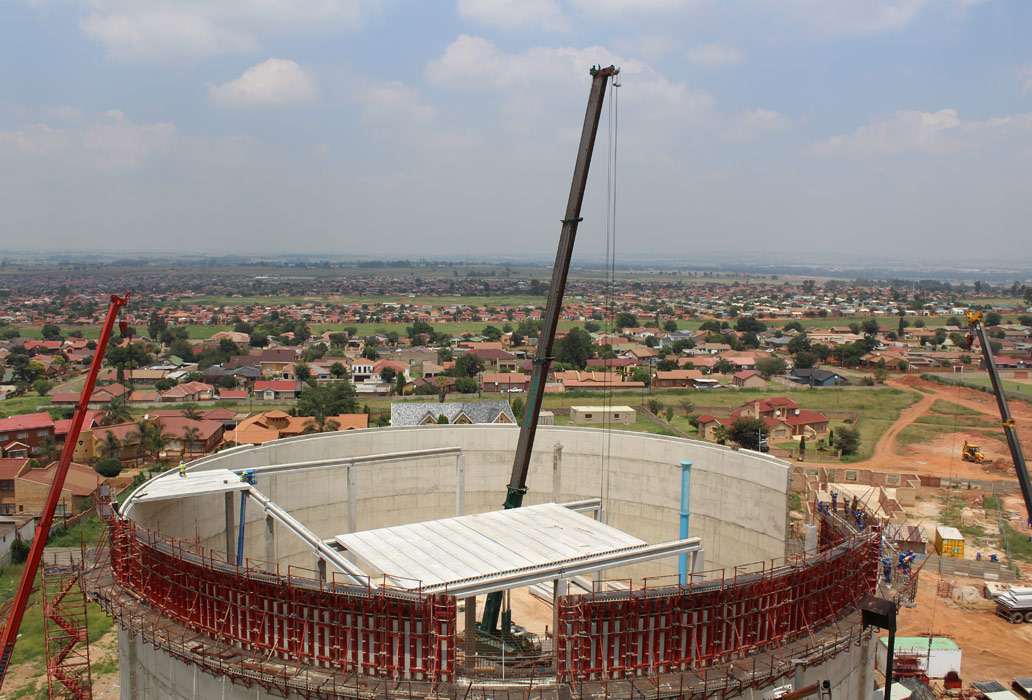
Our modular reservoir system enables the construction of the floor, walls and roof simultaneously to deliver the infrastructure in a fraction of the time it takes using conventional in-situ methods. Approved manufacturers complete the roof and wall systems at our factories in record time while the principal contractor undertakes the earthworks and the reservoir floor. This is opposed to conventional in-situ techniques where work is restricted to one or two faces at any given point in time.
Corestruc first installs the centre portion of the roof system, comprising precast-concrete columns, beams and hollow-core slabs. The process starts with the installation of the columns onto the in-situ bases that have been prepared by the principal contractor while maintaining constant interaction with Corestruc to ensure high levels of accuracies. Led by a seasoned surveyor equipped with a state-of-the-art theodolite, we are able to achieve tolerances of between about 20 mm at heights during the installation of the roof structure.
Corestruc starts dispatching the wall panels to the construction site on a just-in-time basis once the ring beam has been completed by the main contractor. They are lifted directly from our truck trailers and placed on top of the ring beam using our own mobile crane. The first panel is supported by props that are removed once it has set and the remaining precast-concrete elements are then placed against the other to complete the reservoir wall. Again, Total Station technology is used to precisely install each panel, with our team maintaining tolerances of about 5 mm. We are able to manufacture up to 10 reservoir wall panels of various widths and lengths at a time at our factories. This is in addition to the four buttresses that are used to reinforce the wall during the post-tensioning process.
Corestruc’s unique grouting and post-tensioning process ensures a watertight structure. We use vertical and horizontal tensioning to resist applied forces. This is opposed to conventional construction methods where reinforcing and post-tensioning is used to control applied forces. Meanwhile, the grout has been designed to reach a compressive strength of 100 MPa within four days and to further react when the medium comes into contact with water when the reservoir is being filled.