Precast concrete technologies complement labour-based construction

Precast concrete provides a safer means of building
January 17, 2018
Infrastructure specialists help municipalities accelerate service delivery to poor communities
February 8, 2018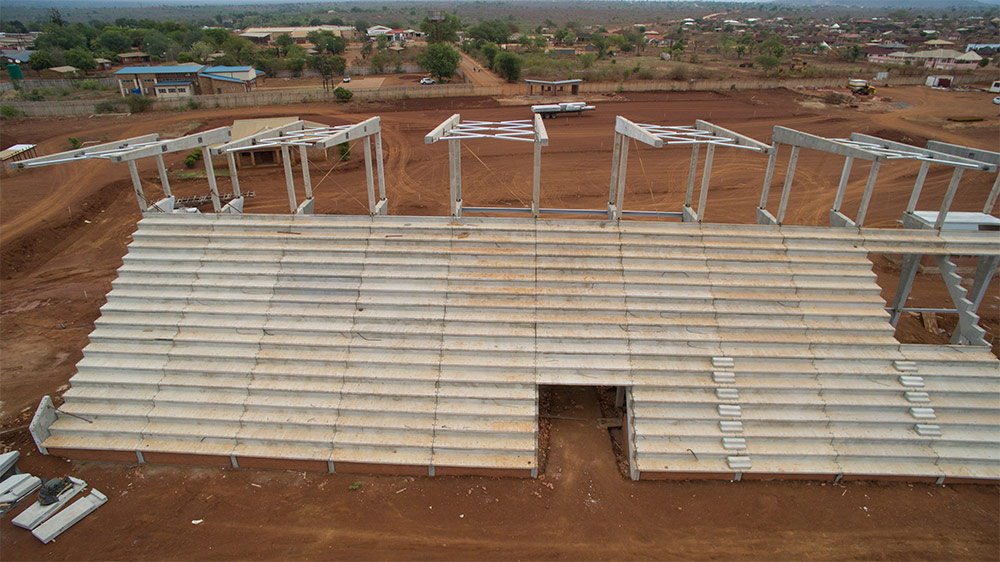
Precast concrete technologies are playing a key role in helping municipalities deliver essential infrastructure, including sports and recreational facilities.
By harnessing the main benefits of this technology, namely speed and ease of construction, these public-sector bodies that operate at grassroots level are able to accelerate the delivery of this infrastructure to poor communities of the country.
In addition to serving as a vital pipeline of work for emerging contractors, the construction of sports and recreational facilities fulfil a critical role in creating employment opportunities, while functioning as a fertile training ground for so many members of poor communities.
“Moreover, these specialist construction capabilities help municipalities spend their Municipal Infrastructure Grant (MIG), aimed at covering the capital cost of basic infrastructure for the poor. Unfortunately, underspend by municipalities on infrastructure remains a major challenge in the country. At the end of the 2016/2017 municipal financial year, the total underspend on infrastructure was about R15-billion. This translated into more than 30 000 lost construction job opportunities in the country,” says Willie de Jager, managing director of Corestruc.
Corestruc’s specialist skills augment the capabilities of those emerging contractors that are tasked with the main construction works.
Its leading expertise in all aspects of the precast concrete construction value chain helps mitigate much of the risk associated with building the stadia. These are one of the many standout features of these facilities and the most technically complex aspect of the entire construction programme.
The modular method of construction eliminates the need to accurately erect and dismantle formwork, which become more complex and demanding at heights.
Conversely, standard high-quality precast concrete items, comprising columns, raker beams and seating benches, are manufactured in a controlled and secure factory setting. They are then transported to site on a just-in-time basis and installed by small and efficient Corestruc teams.
The company has completed numerous grand stands for municipalities in as little as two weeks or less, depending on the size of the structure.
As standard “tried-and-tested” systems, De Jager says further efficiencies are also realised by the consulting engineer in the early design phases of the project.
“These structures are based on an established design that we have refined and perfected over many years. Only minor changes have to be made to accommodate the varying seating requirements, as well as the facilities that will be housed inside the precast concrete structure. Importantly, we wanted to design a system that we could manufacture and install as swiftly as possible to facilitate the acceleration of these projects, while providing the client with a high-quality structure that will continue to add value for many years,” he says.
The installation of the system commences once the foundation work has been completed by the emerging contractors. Meanwhile, these small, medium and micro enterprises also undertake the external and internal brick work, as well as the fitting out of the structure.
These activities complement the many work and skills development opportunities that also arise during other components of the sports facility construction programme. The work scope spans general labour-based civil construction and building operations.
Considering the many benefits that they bring to poor communities long before they are completed, De Jager says that it is critical that government continue driving these infrastructure projects that are closely associated with the Expanded Public Works Programme (EPWP).
“The EPWP currently creates more than 720 000 infrastructure-related employment opportunities in the country every year. Work opportunities average about four months and have mainly benefited youth without a matric by providing them with the skills they need for the modern labour market. Corestruc is proud to be playing its part of this achievement and looks forward to helping government find ways of accelerating more of these projects,” he concludes.