
Durable and aesthetically pleasing grandstands for municipal sports and recreational centres

Corestruc takes precast-concrete technology to new heights
April 11, 2024
City builds Africa’s first precast-concrete water tower
August 2, 2024
Municipal sports and recreational centres are essential basic services infrastructure that can play a key role in uplifting communities. However, there are still many low-income communities in the country that do not have suitable spaces where township youth can participate in sports.
Taking the form of the Municipal Infrastructure Grant and Neighbourhood Partnership Grant, funding for these projects is often underutilised. Many municipalities simply lack the capacity to administer the funding and ability to implement planned projects. There have also been instances where funds provided by the National Treasury for these projects have been used by municipalities for other seemingly more important purposes. In extenuating circumstances, there have even been instances where communities have received sub-standard facilities that have also been vastly overpriced.
Yet, there are enterprising municipalities that are not only delivering quality sports and recreational facilities to their constituents. They are ensuring that these projects already start benefiting many community members during the construction phase. This while also working closely with their professional teams to innovate more effective ways of executing these projects. Harnessing innovative building technologies and methods, aesthetically pleasing infrastructure is being built in a very short timeframe and in a cost-effective manner. The exponentially high standard to which the infrastructure has been built also reduces operating costs over the long service life of the structures.
Certainly, a case in point are the many sports and recreational centres that Corestruc has helped to deliver while working alongside principal builders who are determined to scale the ranks of the Construction Industry Development Board’s Register of Contractors. This will enable them to take on even larger and more complex projects.
By harnessing Corestruc’s extensive precast-concrete knowledge, these contractors are making light work of these projects, while also providing infrastructure that is of an unrivalled quality, both in terms of durability and aesthetics.
The most complex aspect of municipal sports and recreational centres are the grandstands. Building a high-quality cast-in-place concrete structure requires specialist skills and capacity that have not yet been developed by the contractors appointed to work on these projects. Note that these projects also serve as an important catalyst for black-owned construction small, medium and micro enterprise development. As principal contractors, they are responsible for constructing the other important components of these facilities, such as the pitch; changing rooms; and administration building. This while also creating employment, as well as skills development and training opportunities for communities that reside within the operational footprint. These meet the requirements of government’s Expanded Public Works Programme.
Even so, in-situ concrete grandstands take an extraordinarily long time to build. These structures also carry a hefty price that is beyond the reach of many municipalities.
As opposed to building sub-standard structures with other construction materials that do not provide the same durability and aesthetics as concrete, enterprising municipalities and their professional teams are specifying Corestruc’s unique prefabricated concrete grandstands for their projects.
Designed specifically for these projects, this standardised system can be deployed quickly with only minor modifications having to be undertaken to mainly cater to varying number of spectators from one facility to the next. Having finalised these details during the very early design stages of the project, Corestruc can commence with the manufacture of the system as early as possible. In this way, the various precast-concrete elements that make up the system are ready to be integrated immediately after the earthworks; site terracing; and in-situ foundations have been completed by the principal contractor.
Throughout these early phases, Corestruc maintains close contact with the main contractor. This ensures that there no errors that can delay the project.
Once the foundations have been completed, Corestruc mobilises to site to complete the integration of the system quickly and efficiently.
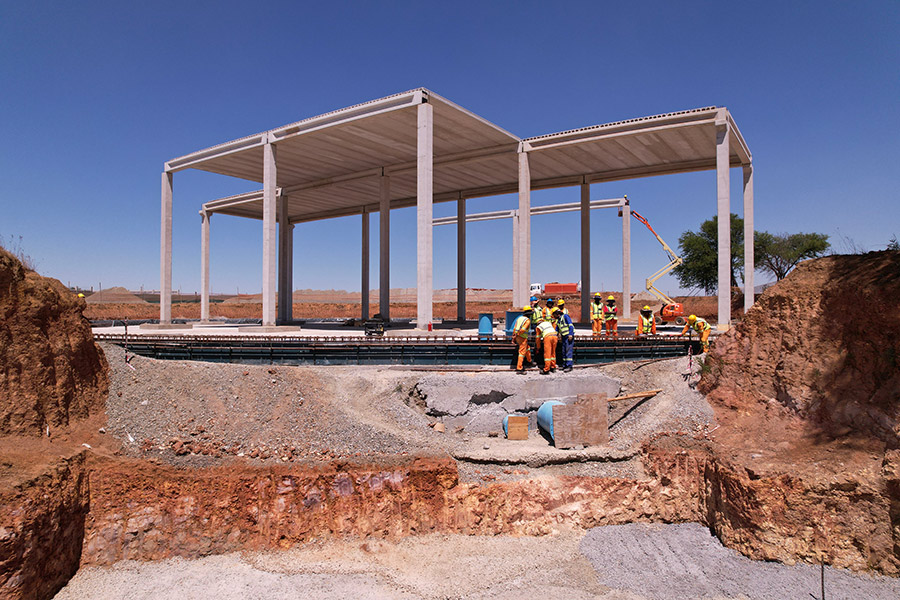
More recently, the company constructed a large grandstand consisting of more than 800 precast-concrete elements and 22 grids in only four months. 14,9m in height at the back columns and 121m in length, this is one of the largest grandstands that Corestruc has built to date. It was also up to 40% more cost-effective than in-situ construction. This is by eliminating the need to manufacture bespoke shutters and operating a tower crane for almost 12 months on site, among other preliminary and general costs associated with such a project. Furthermore, by standardising the system, Corestruc can fix construction costs. This facilitates accurate budgeting and avoids cost-overruns. Precast concrete also addresses the delicate cost concerns associated with scheduling a typical cast-in-place construction project. By eliminating logistical concerns, scheduling becomes easier which, in turn, helps to ensure that unexpected costs do not accrue.
Meanwhile, smaller precast-concrete grandstands have been constructed in a matter of weeks and have also proved to be a cost-effective method of constructing an aesthetically appealing and durable structure to seat spectators.
Corestruc has perfected the design of its system over many years to enable rapid integration of the system components on site.
The number of precast-concrete elements required to construct a grandstand have been minimised and standardised. Moreover, curved columns and rakers, benches and side panels facilitate efficient installation.
The manner in which the various precast-concrete elements are connected has also been simplified. The columns are connected to the in-situ bases by components that have been cast into the precast-concrete elements. They are then easily secured using hold-down bolts. The raker beams, seating benches and side panels are held with strategically positioned dowels. They fit seamlessly into the sleeves that have been cast into the various precast-concrete elements and into which the grout is then poured.
Notably, Corestruc’s riggers achieve tolerances of 5mm when connecting the columns to the foundations and 5mm when integrating the other components of the system. This is made possible by the high level of accuracy achieved in the design of the system and manufacture of each individual precast-concrete element that makes up the grandstand. Of course, this also contributes to the very high durability of these structures.
Corestruc’s engineers use sophisticated commercial software for structural analysis and design. Building Information Management (BIM) systems are deployed to model the structures and each precast-concrete element. BIM improves quality control by enabling seamless tracking and tracing of every precast-concrete element from their design phase through to integration on site. It also facilitates quick and efficient communication between all stakeholders. This includes clients and their implementing agents; consulting engineers; principal contractors; and the specialist precast-concrete sub-contractor, as well as its engineers which lend additional technical support.
The precast-concrete elements are cast in forms manufactured from steel that has been precisely cut for purpose with lasers. They have also been designed to facilitate the accurate placement of the various cast-in components. Moreover, computerised batching plants facilitate optimised curing processes to further reduce lead time.
In addition to those deployed in the precast-concrete factories, quality control checks are conducted after the transportation of the prefabricated concrete elements to site. This is another important component of the precast-concrete value chain over which Corestruc has complete control. The precast-concrete elements are carefully loaded onto and affixed to the company’s tri-axle flatbed trailers. Although they have had enough time to harden fully, extreme caution must still be exercised to avoid damaging them.
As an additional precautionary measure, quality control is also undertaken during the various phases of construction.
The middle columns are the first to be placed. They are set out with coordinates to confirm the plumb and position. The front raker beams are then aligned with the top and bottom bolts of the columns and fastened in place. Corestruc then places the rear columns and braces them with structural steel. This provides the necessary stability at this stage of construction considering the slenderness of the columns. The top raker beams are then installed in the same way that the front elements are placed. Afterwards, they are braced horizontally in a similar sequence to that used for the back columns. This is followed by the installation of the seating benches. They are lined up with the raker beams and then grouted into position and, in doing so, forming a single monolithic structure. Thereafter, the side panels and steps are installed. The roofs of the structures vary from one sports and recreational centre to the next but are predominantly constructed using structural steel with sheet metal as the cover.
“Our grandstands are just one example of the potential that precast concrete can play in addressing many of the challenges facing our country. We will continue to take the lead by using the technology as a basis for faster, as well as more efficient and cost-effective municipal infrastructure delivery,” De Jager concludes.


6 Comments
toradol onset
toradol onset
avanafil dietary interactions
avanafil dietary interactions
augmentin antibiotic guide
augmentin antibiotic guide
clinical guide to sildenafil
clinical guide to sildenafil
how sildenafil affects cGMP
how sildenafil affects cGMP
tadalafil information center
tadalafil information center